


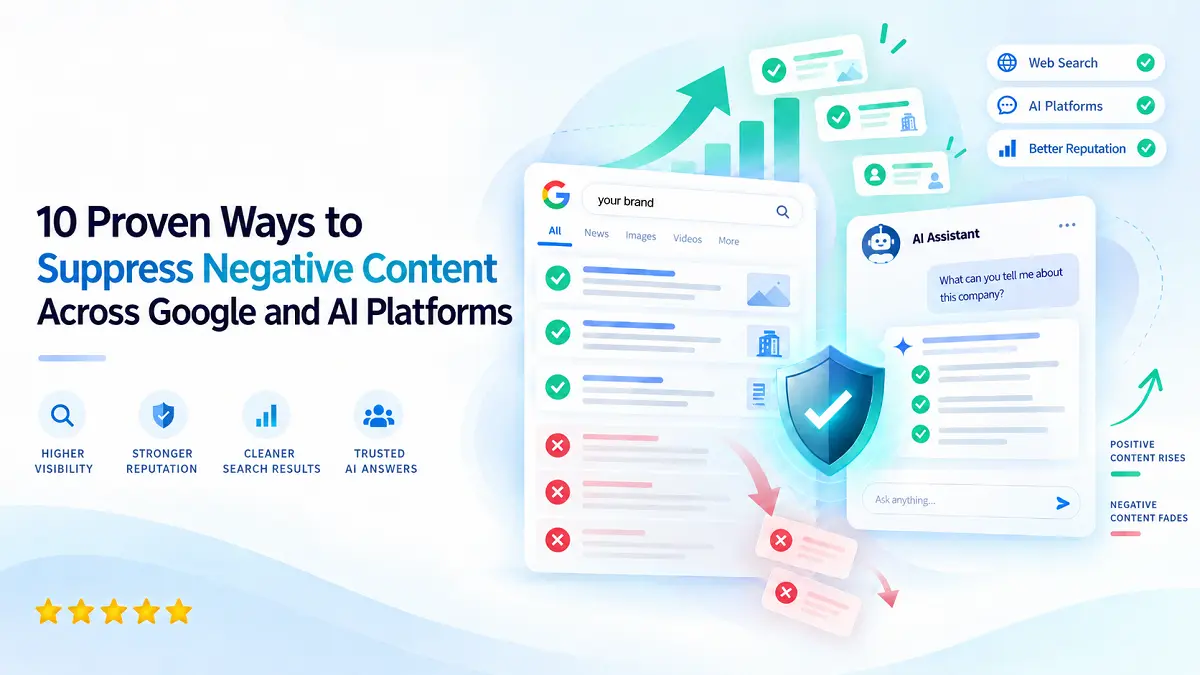
10 Proven Ways to Suppress Negative Content Across Google and AI Platforms
A brand’s online reputation can influence how customers, investors, employees and business partners perceive it before any direct interaction takes place. A single negative article, complaint, outdated review or misleading search result can quickly shape public opinion, especially when it appears prominently on Google or is referenced by AI-powered platforms.
Today, reputation management goes beyond improving traditional search results. Businesses must also consider how they are represented across AI search engines, generative platforms, review websites, social channels and other digital sources that influence online perception.
This is where ORM, or Online Reputation Management, becomes essential. Effective reputation management does not mean hiding legitimate criticism. Instead, it focuses on building a stronger, more accurate and authoritative digital presence so that one negative result does not dominate the entire narrative.
Here are ten proven ways to suppress negative content across Google and AI platforms.
1. Identify Negative Content and Understand Its Visibility
The first step is to understand exactly what is appearing when people search for your brand.
Search your company name, leadership names, products and other branded terms across Google and major AI-powered search platforms. Look beyond page one and identify:
- Negative news articles
- Poor customer reviews
- Complaint pages
- Forum discussions
- Outdated information
- Social media criticism
- Incorrect business information
- Unfavourable videos or images
It is also important to understand which pages rank highest and why. A negative article from a high-authority publication may be more difficult to outrank than an isolated complaint on a low-authority forum.
Professional ORM Services typically begin with a detailed reputation audit to determine which negative results require immediate attention and which can be addressed through long-term content optimisation.
2. Build Stronger Positive Brand Assets
One of the most effective ways to suppress negative search results is to create authoritative digital assets that can rank above them.
These may include:
- An optimised corporate website
- Leadership profile pages
- Product and service pages
- Company news sections
- Case studies
- Knowledge centres
- Author pages
Media coverage - Business profiles
- Social media profiles
Each asset should provide useful, accurate and trustworthy information about the brand.
The objective is not to publish large volumes of weak content. Google and AI platforms increasingly favour high-quality sources that clearly demonstrate expertise, credibility and relevance.
A strong Online Reputation Management Company will therefore focus on creating valuable brand assets that strengthen the overall search ecosystem around the business.
3. Optimise Existing Positive Content
Businesses often already have valuable online content that is underperforming.
A company interview, positive customer story, industry award, thought-leadership article or successful case study may exist online but rank far below negative content.
Optimising these assets can help improve their visibility.
Important areas to review include:
- Page titles
- Meta descriptions
- Headings
- Internal links
- Brand mentions
- Author information
- Structured data
- Page speed
- Content freshness
- Relevant keywords
Updating older positive content can sometimes generate faster results than producing completely new pages.
For example, a well-written company profile that already has some search authority may move significantly higher when supported by better internal linking, refreshed information and stronger on-page SEO.
4. Create High-Quality Thought Leadership Content
Thought leadership is one of the strongest tools available for building a positive search presence.
Executives and subject-matter experts can publish valuable content around topics relevant to their industry. This helps establish authority while increasing the number of credible pages associated with the brand.
Possible formats include:
- Expert articles
- Industry analysis
- Research reports
- Opinion pieces
- Guides
- Interviews
- Podcasts
- Webinars
- LinkedIn articles
Thought leadership is particularly valuable for AI platforms because generative search systems often look for sources that demonstrate clear expertise and provide reliable information.
A well-planned ORM strategy therefore combines reputation management with content authority. Instead of simply responding to negative information, the brand builds a broader digital footprint that gives search engines and AI systems more trustworthy sources to reference.
5. Earn Positive Media Coverage and Digital PR Mentions
Third-party credibility can be more powerful than self-published brand content.
Positive coverage from recognised publications, business websites, trade media and industry platforms can significantly improve search visibility.
Digital PR campaigns may focus on:
- Company milestones
- Original research
- Expert commentary
Industry insights - New partnerships
- Innovation
- Leadership perspectives
- Corporate initiatives
When reputable websites publish positive or neutral information about a company, these pages can compete directly with negative results in search.
A Digital Marketing Agency with expertise in SEO, PR and reputation management can coordinate these campaigns to ensure that earned media supports both brand visibility and search suppression goals.
However, quality matters. Publishing promotional content across low-quality websites rarely creates meaningful long-term results.
6. Strengthen Your Presence on High-Authority Platforms
Google frequently ranks well-established third-party platforms for branded searches.
Businesses should therefore maintain accurate and active profiles across relevant platforms such as:
- YouTube
- Industry directories
- Professional associations
- Review platforms
- Business listing websites
- Social networks
- Knowledge databases
These profiles should be complete, consistent and regularly updated.
High-authority profiles often have strong ranking potential because the platforms already have significant domain authority.
They can also influence AI-generated answers because AI systems often analyse information from multiple trusted sources when forming brand-related responses.
Consistency is critical. Company descriptions, executive roles, locations, services and other important details should remain aligned across major digital platforms.
7. Improve Review Management
Customer reviews play a major role in online reputation.
Negative reviews cannot always be removed, but businesses can reduce their impact by encouraging a larger volume of genuine positive feedback.
A strong review strategy should include:
- Requesting feedback from real customers
- Responding professionally to criticism
- Resolving legitimate complaints
- Monitoring major review platforms
- Avoiding fake or incentivised reviews
- Identifying recurring customer issues
Responses to negative reviews should remain calm, helpful and factual.
For example, instead of becoming defensive, acknowledge the concern and offer a clear way to resolve the issue.
Effective ORM Services treat review management as both a reputation activity and a customer experience strategy. When businesses fix the underlying causes of complaints, they improve both their public reputation and operational performance.
8. Use SEO to Push Positive Results Higher
Search engine optimisation remains one of the core methods used to suppress negative content.
The goal is to increase the authority and relevance of positive pages so they can outrank unwanted results.
Common SEO techniques include:
- Keyword optimisation
- Internal linking
- Link building
- Content updates
- Technical SEO improvements
- Schema markup
- Authority building
- Content clustering
For branded reputation campaigns, it is often useful to create several high-quality pages targeting different variations of branded searches.
For example, a company may optimise content around:
- Brand name
- Brand reviews
- Brand leadership
- Brand services
- Brand news
- Brand customer experience
This creates a more diverse and controlled search landscape.
Suppression usually takes time, particularly when negative pages come from highly authoritative websites. Sustainable ORM focuses on gradually building stronger alternatives rather than expecting instant removal.
9. Optimise Your Brand for AI Search
Online reputation management is no longer limited to Google.
People increasingly ask AI platforms questions such as:
- “Is this company trustworthy?”
- “What are customers saying about this brand?”
- “Is this business reputable?”
- “What problems have been reported about this company?”
AI-generated answers may pull information from websites, reviews, media articles, forums and other online sources.
To improve brand representation in AI search, businesses should create clear, factual and well-structured information across authoritative sources.
Important strategies include:
- Publishing expert content
- Maintaining accurate company information
- Building authoritative third-party mentions
- Strengthening entity consistency
- Using structured data
- Addressing misinformation
- Creating frequently updated brand resources
- Ensuring leadership and company information is easy to verify
An experienced Online Reputation Management Company should now consider both search engine results and generative AI visibility when developing reputation strategies.
The more credible information available about a brand, the better chance AI platforms have of presenting a balanced and accurate picture.
10. Monitor Your Reputation Continuously
Reputation management is not a one-time project.
Search results, reviews, news coverage and AI-generated responses can change quickly. A company that appears positively today may face a new issue tomorrow.
Ongoing monitoring helps businesses identify emerging threats before they become major reputation problems.
Track:
- Branded search results
- News mentions
- Review platforms
- Social conversations
- Executive mentions
- Competitor comparisons
- AI-generated brand answers
- Search suggestions
Regular monitoring also reveals whether suppression strategies are working.
Businesses can measure changes in rankings, sentiment, review scores, positive content visibility and the presence of negative results on page one.
A specialised ORM team in Digital Marketing Agency can combine monitoring, SEO, content, digital PR and analytics to maintain a stronger digital reputation over time.
Final Thoughts
Negative content can influence purchasing decisions, partnerships, recruitment and long-term brand trust. However, one unfavourable result does not need to define how a business is perceived online.
Successful reputation suppression requires a combination of strong content, technical SEO, digital PR, review management, brand authority and AI search optimisation.
The objective is not simply to push negative content down. It is to create a richer and more credible digital ecosystem around the brand.
Businesses investing in professional ORM Services should focus on sustainable reputation building rather than short-term manipulation. A reliable Online Reputation Management Company will help strengthen positive assets, improve search visibility and ensure that accurate information has a greater chance of appearing across both Google and emerging AI platforms.
As search behaviour continues to evolve, businesses that actively manage their digital presence will be better positioned to protect trust, influence brand perception and maintain control over how their organisation is represented online.